How physical labor is used to discuss the difficulty of sustaining life and loss.
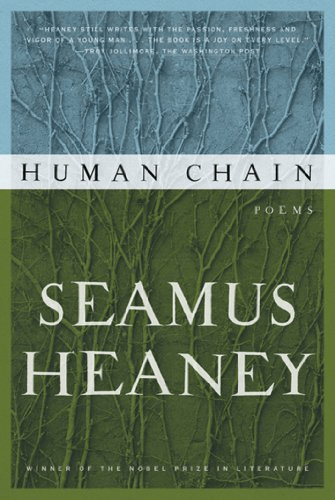
Human Chain is a book that talks about the difficulty of sustaining life and the loss of loved ones, using the language of physical labor – lifting, carrying, handing-off, and unburdening.
The beginning of the book is largely concerned with the passing of the speaker’s father: the huge effort of seeing him through his final days, and the unburdening afterward. One poem, “Miracle”, gives us an image of the pallbearers, “Their shoulders numb, the ache and stoop deeplocked”, who relieve themselves of the burden and wait for “Their slight lightheadedness and incredulity / To pass”. In the titular poem, “Human Chain”, he describes standing in a fire-line, conveying bags of meal onto a truck: he says, “Nothing surpassed / That quick unburdening, backbreak’s truest payback. / A letting go which will not come again. / Or it will, once. And for all.”
The unburdening is described, but also the grief, which might be felt for longer: In “Chanson d’Aventure”, the speaker is reminded of doing physiotherapy – a lift, of course – and, in the same thought, of learning to work a plow with his father: “Between two shafts, another’s hand on mine, / Each slither of the share, each stone it hit / Registered like a pulse in the timbered grips.” That memory of childhood, similarly, registers with a pulse in his later years.
At times, labor and physical sensations are made to feel infinitely deep for their resonances with the experience of life and death. Other times, we’re reminded that an arm’s-length is the simply limit to what we can reach. In “Album,” the grandson does the reaching “properly,” hugging his grandfather and “proving him thus vulnerable to delight,” but the speaker, with a life of labor under his belt – and, it’s safe to say, longer arms – finds his “very arms” to be failing in his “three tries / at an embrace in Elysium”. The speaker points out the “slipped” Latin root of the word very – “verus” – meaning truth, seeing that he’s run up against the hard truths of limitation, and insufficiency.
Even in youth, as in the poem “Uncoupled,” before the speaker is old enough to participate in the labor unfolding on the farm, he’s described as “perched / On top of a shaky gate,” having been lifted or lifted himself up to it, and he feels the precariousness of the work with his own body while he watches his father working with dealers on the farm, who shout for his attention: “So that his eyes leave mine and I know / The pain of loss before I know the term.” Here, there’s a lovely play on the double meaning of the word “term.”
The pain of loss and the work of loss and life, he goes on to show, are never quite shaken off. In “The Butts”, playfully named with reference to both the papery remnants of cigarettes in the his father’s suits, and the butt of his father’s similarly expended body, the speaker lifts his father and “feels his lightness, / Having to dab and work // Closer than anybody liked / But having, for all that, / To keep working.” In “The Baler”, the resonance between life and the work done in the fields is so deep that the speaker remembers a family friend, at the end of his days, who “could bear no longer to watch // The sun going down / And asking please to be put / With his back to the window.” There is even a sense, in “The Riverbank Field”, of the dead unburdening still as they return to life: “memories of this underworld are shed / And soul is longing to dwell in flesh and blood / Under the dome of the sky.”
But the work that comes with death, the strain, is felt by those who are burdened with helping someone through it. Dying itself is often described in the lightest, most effortless terms: “Like a mote through a minster door.” And throughout, those doing the work around the dying are eventually relieved, as in “Human Chain,” or “Slack”, where coal is dumped from a bag, with both the sound and meaning of the word “catharsis“. So the work, he seems to be saying, is really in getting something from one place to the next, whether it’s a pile of coal or a soul.
And then, after the work is done, death is “a not unwelcoming / Emptiness, as in a midnight hangar // On an overgrown airfield in late summer.” Or a kite, as in “A Kite for Aibhín”, whose “string breaks and—separate, elate—[…] takes off, itself alone, a windfall”. The kite is even cheered on by a crowd of onlookers below. In a beautiful final image, the speaker’s hand is “like a spindle / unspooling.” That is, not lifting, not doing work, but itself being lifted and undone.
Sources:
Heaney, Seamus. Human Chain: Poems. Farrar, Straus and Giroux, 2011.
 Sam Reads Poetry
Leave a comment